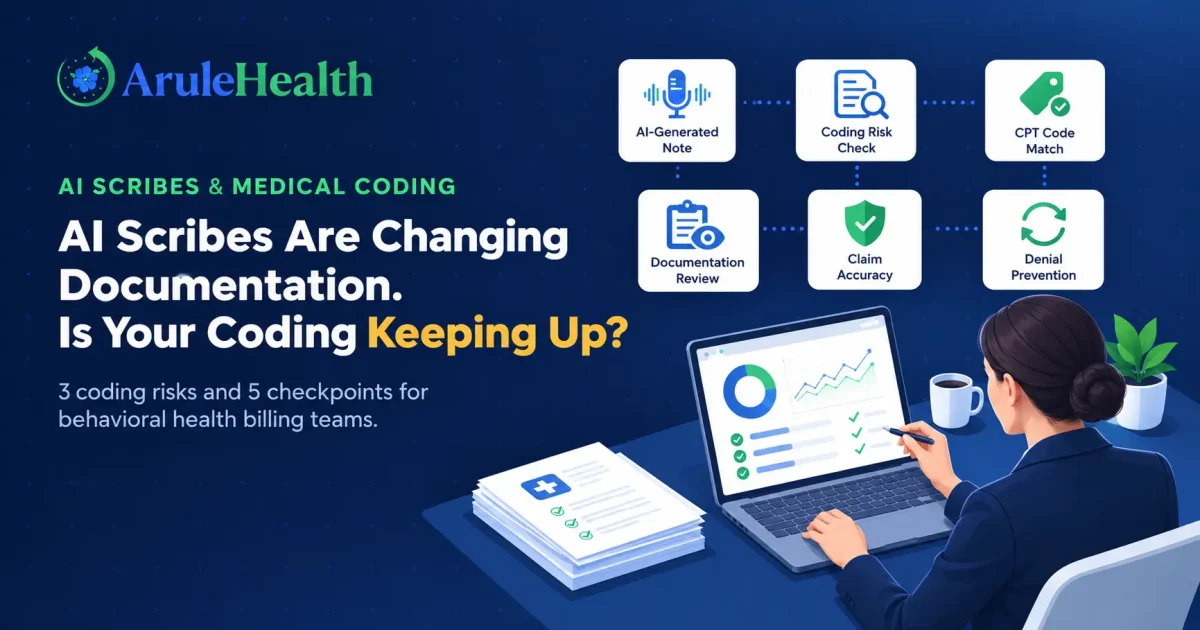
In modern medical billing teams and processes, AI scribes are changing the way clinicians document patient encounters. To speed things up and boost accuracy, clinicians are turning to AI tools to capture crucial details and conversations in clinical notes.
A 2024 Stanford study conducted on 45 physicians across eight ambulatory specialties revealed that introducing an AI scribe reduced 6.89 minutes in daily documentation time and 19.95 minutes in total daily EHR time. However, seamless behavioral health billing needs more than just faster documentation.
Here are a few things to know if your behavioral health practice has already implemented AI scribes or planning on it.
An AI-Generated Note Is Not a Billing-Ready Note
AI scribes help turn conversations into structured clinical notes, but cannot replace the clinical review of coding or provider before claim submission.
Your billing team will still need to determine whether the documentation supports the billed service. The documentation can include time spent, CPT code, medical necessity, diagnosis, provider information, and modifiers among other specifics.
Being aware of the specifics matters, because even AI-generated notes that look complete may be missing crucial billing information. For example, a psychotherapy note may contain a detailed summary of the patient’s condition and discussion but fail to provide the billable code or time.
So the most important question you should be asking if you have implemented AI scribe in your practice is not whether AI has generated a good note, but whether it is supporting the claim you are submitting.
3 Coding Risks to Watch When Using AI Scribes
Now, let’s look at three coding risks you should be aware of and watch out for, if you are using AI scribes in your behavioral health practice:
Longer Notes Don’t Mean Higher-Level Codes
To put it simply, a long or more detailed AI-generated note does not necessarily support a high-level code. While AI is likely to generate longer notes as it captures more information from conversations, the amount of text in a note should not be a reason to select a higher-level service.
Moreover, coding for E/M services must be based on applicable coding requirements, including qualifying time-based criteria and medical decision making. The billing team should focus on what documentation supports rather than how long the note is.
Behavioral Health Has Its Own Documentation Traps
Behavioral health billing has several time and service-specific requirements boosting the importance of documentation review. Psychotherapy codes 90832, 90837, and 90834 are time-based and codes like 90836, 90838, and 90833 are add-on codes reported with an E/M service.
An AI-generated note must include these important details clearly:
- What type of service was provided?
- How much time was spent on the service?
- Does the documentation clearly support the mentioned CPT code?
- Is the diagnosis relevant to the service?
- Are all the necessary requirements satisfied and details included?
AI Can Introduce Errors Without Anyone Noticing
The biggest misconception you can carry into the process is that AI-generated notes are error-free even without a human review. An AI tool can omit a detail, attribute information incorrectly, or even misunderstand a statement. Even a minor error like this could end up creating a billing or coding problem.
Your billing team should review and finalize the clinical note before it becomes a part of the medical record and validate whether the documentation supports the claim.
It’s worth reviewing from both sides: many payers are now also using AI to review and flag claims, so a documentation gap introduced by an AI scribe on your end can meet an AI-assisted review on the payer’s end, compounding the risk of denial.
What Your Billing Team Should Check in an AI-Generated Note
While your billing team doesn’t need to rewrite every AI-generated note, it simply needs to identify issues and errors that may become billing problems or lead to claim denials.
Here are the five checkpoints you must implement when reviewing AI-generated notes:
- Ensure that the documented service aligns with what is being billed
- Ensure that the documentation supports the required time, especially for time-based psychotherapy services
- Double-check whether the diagnosis mentioned on the claim accurately describes the actual condition
- Check whether all the modifiers, telehealth details, provider information, and other payer-specific requirements are complete and accurate.
- The clinician needs to review and finalize the record first and only then be moved from the AI tool to the claim.
Build an AI-Aware Coding Review Process
The goal of building an AI-aware coding review process is to prevent slowing down the efficiency gains that made AI adoption perfect for your practice, in the first place.
Consider creating a simple coding review process including additional steps like provider review and finalization, and validation of codes in claims. Once the process is in place, you must ensure to track whether the new workflow is actually improving the revenue cycle.
The crucial metrics to consider include:
- Documentation-related denials
- First-pass claim acceptance
- Days in account receivable
- Claims returned for missing information
- Claims requiring coding correction
Accounting for these metrics can help your practice create a clearer picture of AI’s impact on the revenue cycle.
Make AI Documentation Work for Your Revenue Cycle
AI scribes, when accurate, can reduce the time clinicians and practices spend for documentation. However, faster documentation is only one part of the equation. For behavioral health practices, the final note must support code, time, diagnosis, service, and payer requirements. While AI can help with documentation, your clinical and billing workflows must verify it.
Arule Health helps behavioral health practices connect coding, claim submission, documentation, and denial management into a consistent billing process. Request a behavioral health billing audit from our website, before you move forward with the decision of implementing AI scribes for your operations.
Frequently Asked Questions (FAQs)
Can a longer AI-generated note justify a higher E/M level? No, the length of your note alone does not determine the appropriate E/M level. Rather, the service must meet the applicable coding requirements depending on medical decision-making or qualifying time.
What should behavioral health practices check in AI-generated notes? Behavioral health practices should check that the CPT code being submitted aligns with the documented service, time, diagnosis, and medical necessity. Pay extra care to the documented time for time-based psychotherapy codes.
Who is responsible for reviewing an AI-generated clinical note? The clinician or doctor should review the AI-generated note to verify whether it accurately captures all the information from the encounter. The billing or coding team should then verify whether the finalized documentation supports the claim.
How can AI scribes affect behavioral health claim denials? AI scribes must prioritize accurate, complete notes to reduce documentation-related issues, and eliminate errors or omissions that can lead to billing or coding issues. Practices should monitor the denials and coding corrections to identify any recurring issues and eliminate them.