Behavioral health and urgent care practices already struggle with insurance claim denials.
As insurers increasingly rely on AI for claims processing and prior authorization, billing teams and managers have to face challenges from decisions influenced by automated systems that may miss out on a patient’s clinical circumstances or the documentation submitted.
In 2025, a survey by National Association of Insurance Comissioners (NAIC) found that 84% of surveyed health insurers admitted to using AI or ML in some capacity. This highlights the urgency of adopting a deliberate approach to denial prevention, documentation, and appeals.
Let’s delve into the role AI plays in modern medical billing processes.
How AI is Changing Insurance Claim Reviews
Insurers can use AI and related algorithms to flag claims for review, identify potential billing errors, and support medical necessity decisions. Some systems also help process documentation and identify claims requiring additional context.
Such applications can streamline routine claims processing workflows, however, an individual patient’s needs may not get accurately represented if it relies on incomplete information, historical decisions or predictions.
The underlying lesson is that an automated decision is not necessarily a correct decision. In behavioral health billing, reviewing actual reasons for denials, checking the policy details, and alignment with clinical and administrative information is more important than ever.
Why Different Specialties Face Different Denial Risks
Even with AI-integrated workflows, your claims might still get denied due to existing billing and documentation issues. The specific risks faced by different specialties may include missing authorization details or insufficient medical necessity documentation in behavioral health practices. Other than that, incorrect place of service coding and unsupported E/M levels, and insufficient documentation can also pose risks for urgent care and pain management facilities.
These risks are not necessarily associated with AI-aided processes, however, every practice should always review the actual denial reason and determine whether specific claims meet payer’s requirements.
5 Effective Ways Practices Can Fight Back Against AI-Assisted Denials
Now that we have looked at the use cases of AI in modern medical practices and the risks associated with it:
Make Medical Necessity Clear in Every Record
Even if you have a diagnosis backing your claim, it is not evidence that every service rendered was necessary. The documentation you add to your claim must clarify the patient’s condition, service provided, and clinical rationale for that service. For instance, progress notes must support the treatment provided and the patient’s clinical needs in behavioral health claims.
Solution:
You must review documentation against the payer’s applicable coverage and medical necessity requirements. Avoid using any generic language or information that doesn’t reflect the care actually provided.
Catch Coding and Authorization Errors Before Submission
Automated claim-scrubbing tools flag missing information, invalid code combinations, inconsistent claim fields, and other errors before claims are submitted. Medical practices can use these tools to boost accuracy but a clean claim is not always a payable claim. More importantly, the checks you must conduct depend on your specialty.
Solution:
Create a pre-submission checklist around the services your practices bill most often and keep updating as and when payer policies change to ensure accuracy.
Analyze Denial Patterns by Payer and Service
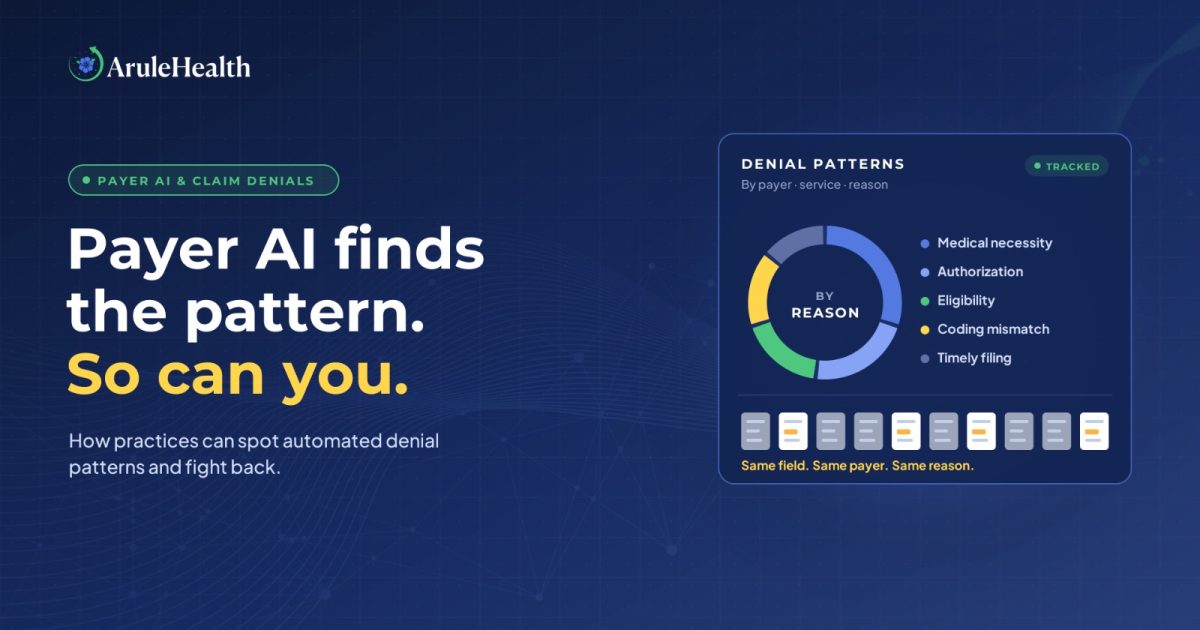
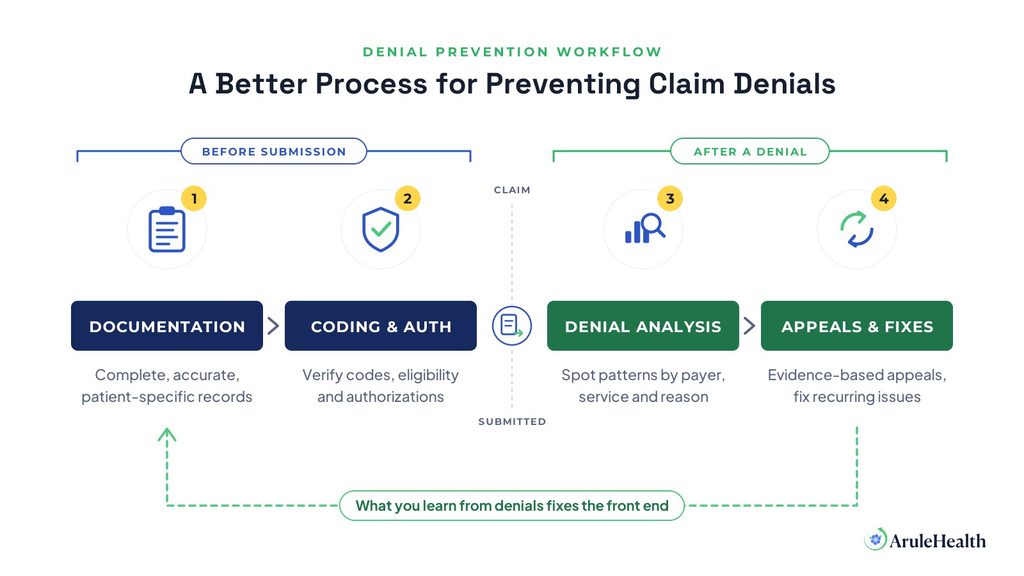
If you are still analyzing and scrutinizing each denial individually, you may end up overlooking the systemic problems. If you are getting repeated denials, you may need to look for a documentation gap or missed payer-specific requirement that may be causing a denial pattern.
For instance, if you notice the claims from your urgent care facility getting denied repeatedly due to incorrect code or place of service combination, it is a pattern you must analyze and correct rather than treat it as an isolated incident.
Solution:
Maintain a denial log that records the payer, description, denial code, date of service, and bill service or procedure and other pertinent information. Then, keep reviewing trends regularly and compare denial reasons with relevant payer policy.
Appeal With Evidence, Not Just a Disagreement
When you file an appeal for a claim denial, it could be stronger if it directly addresses the reason for denial stated by the payer, instead of including general statements. The supporting evidence you provide is crucial, depends on each claim, and must include supporting evidence like relevant progress notes, treatment plan, coding rationale, and necessary documentation.
Solution:
Ensure alignment between your claim and payer requirements by including original claim details, denial notice, relevant records, and applicable policy language. You must also track submission confirmations and deadlines.
Optimize Documentation for Algorithmic Review
If you know that a payer uses AI-assisted processes to review and process claims, you must optimize and structure documentation so the clinical rationale and supporting evidence are easily identifiable, without compromising accuracy or clinical judgment.
This matters even more if your clinicians use AI scribes to draft notes, since an AI-generated note can look complete while still missing the specific clinical rationale a payer’s algorithm is scanning for.
For example, pain management documentation should connect the patient’s symptoms and clinical findings to the procedure performed, including the treatments and pre-authorization details.
Solution:
Utilize specialty-specific documentation templates and consistent terminology, and ensure notes that support the diagnosis, service, code, and medical necessity requirements. Avoid copying generic phrases or adding details solely to satisfy an algorithm.
Build a Stronger Response to Automated Denials
AI is becoming a vital part of insurance operations but that does not mean that every denial is correct or AI-driven. The available evidence shows increasing AI adoption across health insurance, while direct evidence about AI’s role in claim denials remains limited.
For behavioral health, urgent care, and pain management practices, the practical response for AI-assisted claim denials remain consistent. A repeatable denial management process helps practices address individual payment disputes and identify operational issues that affect overall revenue.
Connect with Arule Health to understand how a proactive billing approach can help your practice spend less time on billing issues and more time focused on patient care.
Frequently Asked Questions (FAQs)
- Are insurance payers using AI to deny medical claims?
Some insurers are using AI and ML to adjudicate claims, prior authorization, and utilization management. However, AI may assist or flag a decision rather than make the final determination, and not every denial is AI-driven.
- Can a practice appeal a claim denial that may involve AI?
Absolutely. Medical practices must follow the payer’s appeal process, review the stated denial reason, and submit relevant documentation and policy references. The appeal must focus on why the claim meets the applicable requirements rather than speculate about which technology the payer used.
- How can behavioral health practices reduce AI-related claim denials?
Behavioral health practices can strengthen medical necessity documentation, validate CPT codes, and authorizations, use pre-submission claim checks, and track denial patterns based on the type of payer and service.