A 2024 survey by CDC reveals that 27.6% of Americans had at least one urgent care visit in the prior 12 months.
Urgent care billing is fairly straightforward until a specific encounter is treated differently by different payers. Even when coding is correct, the claim can be denied if the service location, modifier, or payer-specific billing rule is wrong.
For urgent care billing teams, figuring out when to use a specific code, when not to use it, and understanding payer expectations is tricky. All of it starts with gaining a better understanding of applicable codes and processes by the payer.
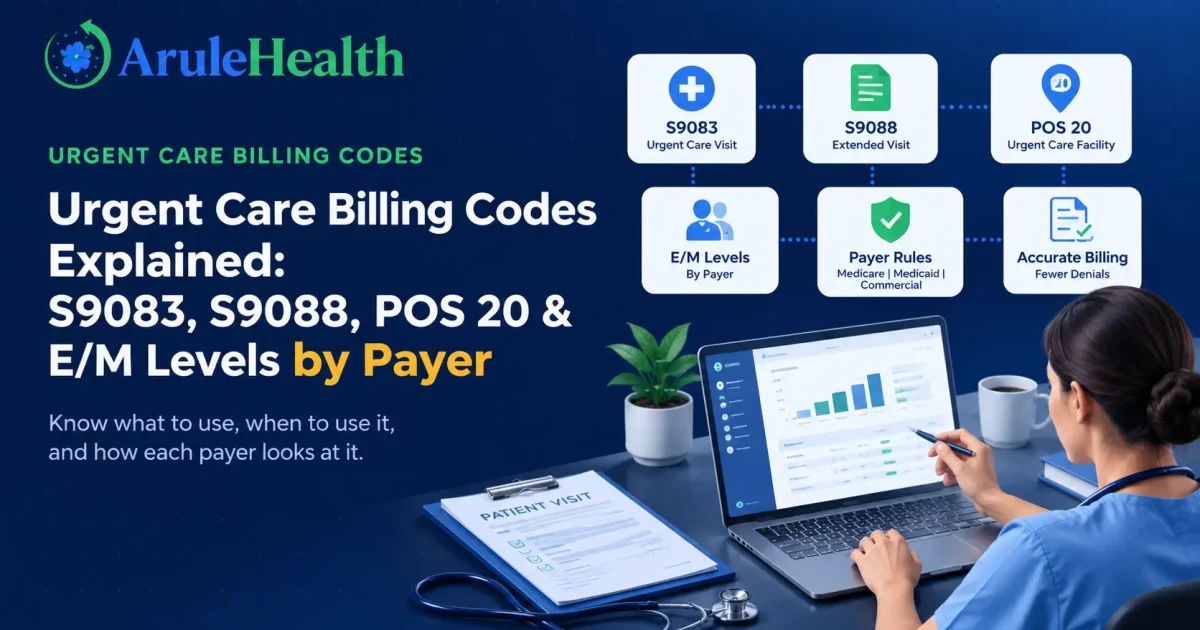
S9083: What is the Global Urgent Care Code?
S9083 is the global code assigned to the global fee for the services provided in an urgent care center.
Unlike an E/M code, which refers to a specific evaluation and management service, S9083 is associated with a global or case-rate reimbursement arrangement. Under this code, the payer may designate one payment for every urgent care encounter rather than reimbursing each component using E/M methodology.
S9083 is not a universal urgent care billing code, and whether your medical practice should report it depends on the payer’s reimbursement policy and contract. Basically, it is better to understand the payer-specific billing rules and assess the applicability of S9083 in a specific case, rather than treating it as a default code.
S9088: What Does the Urgent Care Add-On Code Do?
S9088 describes services provided in an urgent care center and is reported in addition to the specific service code, immediately distinguishing it from S9083. It is important to bear in mind that S9088 is an additional urgent care code reported with the underlying service when the payer recognizes it.
For example, a specific payer might allow an appropriate E/M code plus S9088, but another payer may not reimburse S9088 at all.
A claim may be correctly coded from a CPT perspective but still be denied if a payer does not recognize S9088 under the practice’s contract, causing trouble for billing teams. Before billing S9088, you must check the payer’s current policy rather than relying on a generic urgent care coding rule.
Understanding POS 20
Now, POS 20 identifies the facility where an urgent care service was provided. So the code is designated to a location, and not a specific service. POS 20 distinguishes an urgent care facility from an emergency department in hospitals and other outpatient settings.
Since a payer can still apply their own rules for codes that get recognized, bundled, or separately reimbursed, adding POS 20 to a claim does not increase its payability. For billing administrators, the distinction between POS 20 and other POS codes is useful in investigating denied claims.
E/M Levels in Urgent Care: 99202-99205 and 99211-99215
When an urgent care payer verifies outpatient or E/M billing, the relevant codes considered in the process are usually:
- 99202-99205: New patient visits
- 99211-99215: Established patient visits
According to CMS guidance, E/M level should accurately reflect the service provided and meet the applicable coding requirements. Not every urgent care setting warrants a higher-level E/M code, and the level selection is based on medical decision-making (MDM) or total time on the date of the encounter.
For an urgent care billing team, the review should go beyond asking whether the note is detailed, and check the following:
- Correct classification of patient as new or established
- Alignment of MDM with selected level
- Appropriation of documented time for code selection
- Alignment of diagnosis with condition managed
- Correctness of claim details and modifiers
Ensuring that coding for a claim is done correctly and accurately is important to prevent expensive undercoding or overcoding errors.
How Urgent Care Coding Changes by Payer
One of the most confusing parts about being on the payee end of urgent car billing is that a claim can look very different for Medicare, Medicaid, and Commercial Payers.
While one may recognize S9083 under a global urgent care arrangement, another may ask for specific E/M and procedure codes.
Other payers may even have published policies about the specific circumstances in which S9083 and S9088 can be applied to claims. Maintaining a clear and updated payer-specific billing matrix is crucial in avoiding errors and denials.
Common Urgent Care Coding Mistakes that Cause Denials
Due to the sheer differences in the approach towards urgent care claims from payer to payer, billing departments and medical practices often end up facing denials. The common coding mistakes that can cause denials include:
- Treating S9083 as a universal urgent care code
As mentioned several times till now, S9083 does not automatically apply for every urgent care encounter. Confirm that the payer recognizes the code and that your contract supports its use, prior to making it a part of your standard billing workflow.
- Billing S9088 without checking reimbursement rules
S9088 is usually applied in claims, as an addition to the underlying service code, but not every payer reimburses it separately. You must check whether the payer accepts, bundles, or excludes S9088 before adding it to claims.
- Using POS 20 as a substitute for correct coding
POS 20 tells the payer that the service was provided to the patient in an urgent care facility, but it does not let them know anything about the services provided. So POS 20 will always be included in addition to the service-specific code in any claim.
- Applying one payer’s rules to every claim
Urgent care coding requirements differ significantly for Medicare, Medicaid and other commercial payers. Treating them with a standard rule can lead to denials, which is why you need payer-specific billing rules instead of applying the same S-code, E/M, or POS logic to every claim.
Concluding Remarks
Urgent care coding is not just about knowing what a specific code means and it has a lot to do with knowing the combination that is applicable to each encounter and payer. For urgent care administrators, a payer-specific coding matrix can prevent many avoidable problems. Understand and document how each payer works to prevent denials and improve your claims pass rate.
Arule Health helps urgent care practices manage E/M coding, urgent care-specific billing, ancillary services, and denial follow-up. Opt for a free billing audit so that we can help identify payer-specific rules that are creating avoidable denials.
Frequently Asked Questions (FAQs)
- What is S9083 in urgent care billing?
S9083 is a HCPCS code used for a global urgent care fee and whether it should be reported depends on the payer’s reimbursement policy.
- What is S9088 used for?
S9088 is an additional urgent care code that may be reported along with the underlying service whenever payer recognizes it. However, it must not be considered as a replacement for the appropriate E/M or procedure code.
- What is POS 20 for urgent care?
POS 20 is a code that shows that the services have been provided in an urgent care facility, however, it does not determine the specific CPT or HCPCS code that should be billed as part of the claim.
- What E/M codes are used for urgent care visits?
When standard office/outpatient E/M billing applies, new patients will use E/M codes like 99202-99205 and established patients will use E/M codes like 99211-99215, depending on the applicable requirements.
- Can an urgent care claim be denied when POS 20 is applied correctly?
A correct POS doesn’t always guarantee payment and you may get denials due to unsupported E/M level, an unrecognized S9083 or S9088 code, missing modifiers, bundling or payer-specific reimbursement rule.