
If you are handling the billing or finances for a behavioral health practice, you probably have your eyes set on the 2027 Medicare Physician Fee Schedule already. If not, it’s more than just a pivotal announcement, it deserves more than a quick look, because unlike most annual updates, this one carries genuinely good news for behavioral health alongside a broader rate cut.
In a nutshell, the primary highlights of the 2027 Medicare Fee Schedule that matter specifically to behavioral health practices are:
- Behavioral health services are getting an RVU (Relative Value Unit) adjustment, the final year of a four-year revaluation
- The conversion factor is going to decrease
- New services like tobacco cessation and SBIRT have been added to the final RVU adjustment
- Telehealth flexibilities remain in place through 2027, with a real change coming in 2028
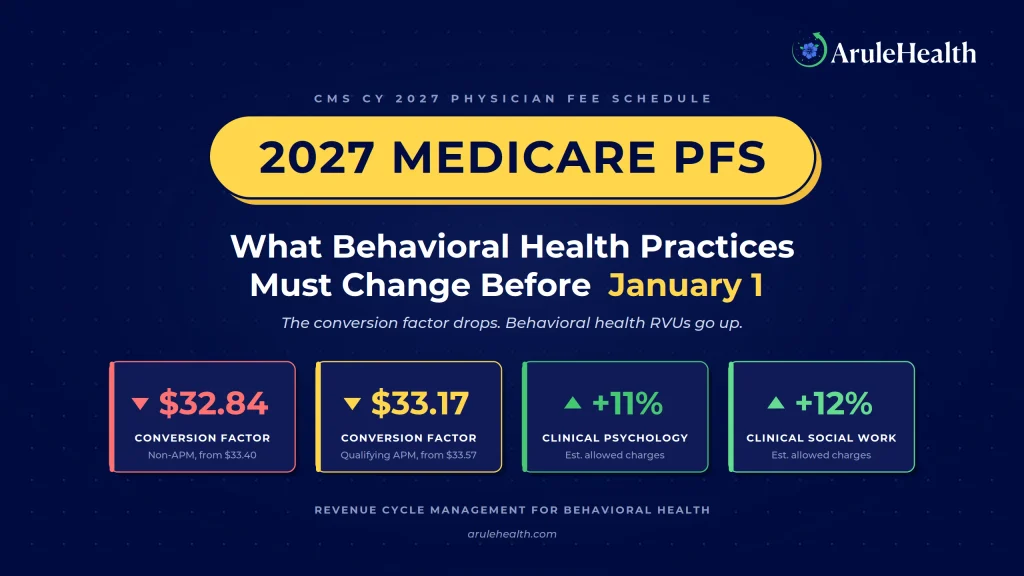
CMS has proposed lowering the 2027 conversion factor from $33.57 to $33.17 for Advanced APM (Alternative Payment Model) participants, and from $33.40 to $32.84 for non-qualifying ones. That’s roughly a 1.2% and 1.7% cut respectively, driven mainly by the expiration of a one-year, temporary 2.5% boost that applied only to 2026.
But for behavioral health practices specifically, the picture is better than that headline cut suggests: this is the final year of a four-year behavioral health code revaluation CMS started in 2024, and it’s projected to increase overall Medicare revenue by roughly 11% for clinical psychologists and 12% for clinical social workers, more than offsetting the conversion factor decrease for most practices.
You must bear in mind these are national-level estimates and don’t indicate what your specific practice will collect. That said, if you represent a behavioral health clinic, here are the things your billing and finance teams should address before January 1.
What This Actually Means in Dollars (2026 Baseline)
Before you can model the 2027 impact, you need to know where you’re starting from. Current (2026) Medicare non-facility national rates for the codes most behavioral health practices bill most often:
- 90791 (psychiatric diagnostic evaluation): approximately $173
- 90834 (45-minute individual psychotherapy): approximately $114
- 90837 (60-minute individual psychotherapy): approximately $167
- 90853 (group psychotherapy): approximately $45-55
These are national averages before your locality adjustment. The exact 2027 rate for each code depends on the final RVU values CMS publishes with the final rule, not just the conversion factor, so don’t try to back into a 2027 number by applying the percentage estimates above to these figures. Use CMS’s official fee schedule lookup tool once the final rule is out.
#1 Don’t Assume Every Medicare Claim Will Pay Less
The 2027 Medicare conversion factor is definitely set to decrease. However, you should not assume this means every behavioral health service or practice will receive lower payments. In fact, for most behavioral health providers, the RVU increases built into this final transition year outweigh the conversion-factor decrease entirely.
What to do: Compare your most frequently billed Medicare codes under the 2026 fee schedule against the proposed 2027 rates once the final RVU tables are published. Don’t apply the conversion-factor change across your entire Medicare revenue as a blanket estimate, behavioral health is one of the few specialties where the RVU adjustment can outpace the cut.
#2 Check Your Top Medicare CPT Codes, and Know Which License Type They’re Billed Under
Which codes does your practice bill most often to Medicare? For most behavioral health practices, that’s psychotherapy (90834, 90837), psychiatric diagnostic evaluation (90791), and medication management. Figure out your top codes by reviewing your own claims data, not national averages.
This matters more in 2027 than in past years because the RVU increase doesn’t apply equally across every license type. Clinical psychologists and clinical social workers are billed directly under the physician fee schedule and get the full benefit of the RVU increase. Licensed Professional Counselors (LPCs), Licensed Marriage and Family Therapists (LMFTs), and Licensed Mental Health Counselors (LMHCs), by contrast, are reimbursed at 75% of the physician fee schedule rate under current Medicare rules. If your practice employs a mix of these license types, model the impact separately for each, a blended average across your whole clinician roster will understate the picture for some staff and overstate it for others.
What to do: Create a basic 2026 vs. 2027 top-Medicare-codes spreadsheet with columns for current rate, estimated payment difference, and provider license type, so you’re comparing accurately within each reimbursement category rather than across all of them at once.
#3 Fix Your Common Denials Before January
If you’re working with a high denial rate on your claims, now is the time to solve it. A higher Medicare payment rate means nothing if your claims keep getting denied.
Analyze your 2026 claims denial data to identify recurring coding, eligibility, documentation, or medical necessity issues your practice can fix to get quicker reimbursement.
What to do: Identify and document your top five denial reasons. Then trace each back to the workflow issue causing it, and fix the recurring ones before 2027 rates take effect, so a rate increase doesn’t just mean a bigger number getting denied.
#4 Check Whether You Are Missing Billable Services
While the 2027 fee schedule includes the standard psychotherapy and behavioral health codes you already bill, it also finalizes RVU increases for less commonly billed ones, including tobacco and smoking cessation counseling and SBIRT (Screening, Brief Intervention, and Referral to Treatment), both being folded into the final year of the behavioral health revaluation.
What to do: Compare every service your clinicians actually provide against the codes on the claims you submit. If your clinicians are already doing tobacco cessation counseling or SBIRT screening as part of a visit and you’re not billing for it separately, that’s revenue you’re currently leaving on the table, and it’s about to be worth more.
#5 Update Your Billing System
It’s never a bad time to update your billing system, but the critical detail is making sure it reflects the final 2027 Medicare fee schedule, not the 2026 rates, and not the proposed rates that are still subject to change through the final rule process.
Apply the same logic to your charge masters, internal fee sheets, and any spreadsheets your billing team currently relies on.
What to do: Once CMS releases the final rule and rates (expected this fall), update your billing settings and fee schedules accordingly. Run test claims or review your first batch of claims under the new rates to catch configuration errors early.
Telehealth: What’s Actually Changing, and When
Telehealth for behavioral health isn’t going away in 2027, but a real change is coming after it. Under the Consolidated Appropriations Act, 2026, Medicare’s telehealth flexibilities, including no geographic restrictions, home as an originating site, and audio-only coverage, are extended through December 31, 2027.
The behavioral-health-specific flexibility to watch is the waiver of the in-person visit requirement. Currently, Medicare patients can receive mental health services via telehealth without ever needing an in-person visit first. That waiver holds through 2027. Starting in 2028, new mental health telehealth patients will need an in-person visit before, and periodically during, ongoing virtual care. Existing telehealth patients and the ability to deliver behavioral health telehealth from a patient’s home are not going away, this is specifically about the in-person-visit requirement for new patients.
What to do: If your practice is building out or expanding a telehealth program for new patients, plan now for how you’ll handle the in-person visit requirement that starts in 2028, rather than treating 2027 as a stable baseline you can build a workflow around indefinitely.
What Remains Unaffected by the 2027 Changes
CMS’s proposed 50% payment reduction applies when a separately identifiable E/M visit is billed by the same physician, on the same day, as a procedure carrying a 0-, 10-, or 90-day global period. Psychotherapy add-on codes like 90833 and 90836 don’t carry a global period themselves, so under the proposal as currently written, billing a psychiatric E/M visit alongside these codes should not trigger this reduction. That said, this specific interaction isn’t spelled out explicitly in what CMS has published so far, so confirm against the final rule language before relying on it, rather than treating it as settled.
If confirmed, this means behavioral health practices can continue billing eligible medication management and psychotherapy services on the same date under the applicable documentation and coding requirements, without the global-period reduction applying.
Where This Stands Right Now
CMS published the CY 2027 Medicare Physician Fee Schedule proposed rule (file code CMS-1848-P) on July 14, 2026. The public comment period closed September 14, 2026. CMS is expected to release the final rule this fall, with the finalized rates and policies taking effect January 1, 2027. Everything above reflects the proposed rule, treat these as strong planning estimates, not locked-in numbers, until the final rule is published.
Frequently Asked Questions (FAQs)
Is the 2027 Medicare conversion factor going up or down? Down. CMS is lowering it from $33.57 to $33.17 for Advanced APM participants, and from $33.40 to $32.84 for non-qualifying ones, roughly a 1.2% and 1.7% cut.
Will behavioral health practices lose money under the 2027 fee schedule? Not necessarily. This is the final year of a four-year behavioral health code revaluation, projected to raise Medicare revenue roughly 11% for clinical psychologists and 12% for clinical social workers, which offsets the conversion factor cut for most practices.
Which codes should behavioral health practices check first? The codes billed most often: psychotherapy (90834, 90837), psychiatric diagnostic evaluation (90791), and medication management. Review your own claims data rather than relying on national averages.
Where can I find the official 2027 Medicare rates? Use CMS’s official fee schedule lookup tool once the final rule is published. The exact 2027 rate for each code depends on final RVU values, not just the conversion factor percentage change.
Turn 2027 Medicare Changes Into a Revenue-Cycle Checkup
If you run a behavioral health practice, the 2027 Medicare changes are more than a fee schedule update, they’re a good forcing function for a broader revenue-cycle checkup. You need to know your top CPT codes by license type, your recurring denial patterns, and whether your documentation supports every service your clinicians are actually providing.
At Arule Health, we help behavioral health practices review and update their Medicare revenue cycle, from coding and documentation to claim submission. Book a free consultation with our team to check your existing billing workflow and identify potential reimbursement gaps ahead of the 2027 changes.